It's time to pause and celebrate. Victories on environmental issues are not that common and it’s
important that we celebrate when we do get one. Please join the Friends of Morice-Bulkley on Sunday,
January 8, to celebrate the end of the Enbridge Northern Gateway
Pipeline project.
As you may have noticed reading the later entries here, Lelu Island remains a serious threat to the people and salmon who make their home in the greater Skeena Watershed. Many of us who came together to stop the Northern Gateway project are still working to keep the mouth of this great river intact.
But I feel Say the Names has done what I hoped it would do. In 2017, I'll be moving my focus to one small part of the watershed, namely Driftwood Creek. I've lived beside the creek for coming up forty years now and I'm planning to create a long and winding love letter celebrating its unique nature and giving thanks for the nurture it has given me and my family during those years.
To keep in touch, you can follow that journey at my website.
Have a wonderful 2017!
Say the Names brings stories from the people who live in the towns and travel the rivers and lakes situated along the proposed route of the Enbridge Northern Gateway pipeline project in British Columbia.
Say the Names...
Al Purdy wrote a wonderful poem called "Say the names say the names" which celebrates the names of Canadian rivers - Tulameen, Kleena Kleene, Similkameen, Nahanni, Kluane and on and on in a celebratory song.
Enbridge is planning to build a dual pipeline that will carry bitumen and condensate across hundreds of waterways between Edmonton and Kitimat. Some of these waterways are rivers like the Parsnip (or what's left of it), the Nechako, the Morice and others are smaller creeks whose names are often known only to the folks who live along their banks or who fish in their shadows or who bend to wash or drink as they cross paths.
I want to collect the names of these rivers and creeks, to collect your stories, your poems, your songs so we can collectively give voice to the land living under the line Enbridge plans to draw.
People have also sent me copies of their presentations to the community oral presentations. If you'd like to add your voice, email me (sheila.peters900@gmail.com) your stories and I'll post them for you. The copyright remains with you.
All the best.
Sheila Peters
Showing posts with label Sheila Peters. Show all posts
Saturday, December 31, 2016
Sunday, October 16, 2016
Lelu Island lace
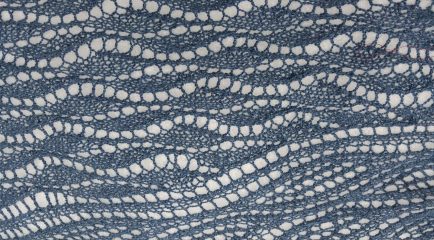
I’m just coming to the end of a lace project called Estuary, by designer Emily Wessel. I was first drawn to knit this shawl by its name. Emily describes her inspiration for this design: An estuary is an in-between place, not ocean, yet no longer river. It is a fertile habitat where sweet and salt water mix, and many species thrive. Estuary combines two lace patterns to create an ambiguous shape: not quite a shawl, yet something more than a scarf.
There are more beautiful – extravagant, filigreed, starbursts, leafy, vine trellised – lace patterns. But I’ve been knitting this shawl to honour the Skeena estuary. In it, I see the Flora Banks emerging as the tide retreats, the salmon finding their way back up the river after their time at sea, all the young smolts collecting in adolescent jitteriness after their first river descent. Both coming and going they feed the eagles, the sea lions, the gulls, the seals. And us too. So many of us fed for thousands of years.
The shawl has been a difficult project for me, partly because I’ve picked it up and put it down many times over the past year, but also because the pattern is complex. By combining two different patterns, it mimics the sweet water meeting the salt and you need to pay very careful attention as it grows.
Lace is often like this. Lose concentration and you can find yourself and your stitches in a muddle. And the thing about knitting lace is it’s almost impossible to correct mistakes. The structure, with all its intentional gaps, the pulling together and drawing apart of threads, means you can’t just unravel it and pick it up again like you can with a plain sock or sweater. The structure you’ve laboured so long to create disappears.
![]() |
| Photo: Tavish Campbell |
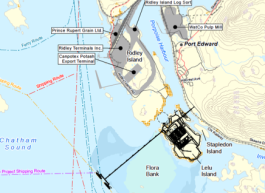
If you plunk an LNG port* on Lelu Island, stretch a bridge across
Flora Banks and the eelgrass where salmon smolt gather to the tanker
dock at the edge of Chatham Sound, drill, blast, dredge and set up a
huge humming structure complete with gas flares and tankers, well you’ve
unravelled something that’s taken thousands of years to emerge from the
debris of our last ice age.How ironic to even consider building this example of Anthropocene hubris in this spot. If you add the expansion to the fracking chaos of northeastern BC this project will necessitate to its enormous greenhouse gas emissions, you’ll be speeding up the final melting of ice that began the process, thousands of years ago to create the Skeena estuary. The melting could well see the whole LNG structure itself lost beneath tidal surges within decades.
Maybe we should send Justin Trudeau, Catherine McKenna and Christy Clark each a fragment of unravelling lace and see how well they can pick up the stitches to re-establish the pattern. All while treading water.
* If you want to know more about Petronas’s LNG project, a project approved by the Canadian government just days before it ratified the Paris agreement on climate change, check out Skeena Watershed Conservation Coalition’s video.
Thanks to Graeme Pole for the images from No More Pipelines.
Wednesday, March 12, 2014
Peter von Tiesenhausen
It's been an overwhelming few months in the pipeline world that we're being dragged into here in northwestern BC. Frankly, it wasn't so much the JRP's recommendation that Enbridge's Northern Gateway pipeline be granted permission to proceed (with over 200 conditions) that overwhelmed me, but rather the plate of spaghetti that constitutes the "plans" for LNG pipelines revealed by a myriad of applications.
It's been our provincial governments touting of LNG as clean energy, even though it is a fossil fuel that has an enormous carbon footprint.
Most particularly it's the knowledge that LNG pipelines = fracking and all that entails: fracking both in ever increasing amounts in the beleaguered northeast, and inevitably (well, not really, I refuse to accept that) into this part of the country.
It's times like this you wonder: what is the point of writing poems, stories, and songs, of creating images and performing acts of wonder, love and encouragement? We're toast, we're hooped, we're fracked.
But then I remembered Peter von Tiesenhausen and cheered right up. He's a visual artist based in northern Alberta whose work challenges the way in which the fossil fuel industry wreaks havoc on our idea of home: In a review of his work in Canadian Art, Robin Laurence writes:
The petroleum industry, of course, casts a long shadow across the region. One of von Tiesenhausen’s legal strategies for resisting the industry’s incursions involved making a claim of copyright to the land on which he has installed a number of his environmental sculptures. It’s the land he grew up on, the land that used to belong to his parents, the land on which he and his family live and work.
Laurence goes on to discuss the way von Tiesenhausen creates alternative ways of seeing home:
As Peter von Tiesenhausen tours me through “Elevations,” his solo exhibition at the Art Gallery of Grande Prairie, it is difficult to gauge whether he is more invested in the work on view here or in the new Demmitt Community Centre, an hour’s drive away. The internationally acclaimed environmental artist and activist talks about each—the art that symbolizes a spiritual journey, and the community centre that he has been instrumental in creating—with equal pride, passion, humour and angst. His conversation reveals how his art practice affected the way the community centre was conceived, and vice versa. Some of the images and materials in his mixed-media show, which functions as a mid-life meditation on creative aspiration and the making of meaning, are directly connected to the realization of the building.
Community = the land itself and the creatures that live on it, in it, with it, from it - including people.
von Tiesenhausen's work includes the evocative The Watchers/Journey and the inspirational Passages. The Watchers consist of a group of charred figures which crossed Canada from 1997-2002, moving from exhibition to exhibition - a spooky and powerful presence wherever they stand.
Passages charts the course of 100 tiny boats filled with earth from 100 different spots between the Bow River's source and Calgary after their release into the river in 2010.
Seeing
images of the hands holding out the tiny boats and letting them fall
into the river reminded me of Ali Howard's first leap into the Skeena
near its source in the Sacred Headwaters. Art and action bring us
together and give us courage. Thanks to all of you who keep our hearts
whole while we struggle to slow down the craziness.
The
petroleum industry, of course, casts a long shadow across the region.
One of von Tiesenhausen’s legal strategies for resisting the industry’s
incursions involved making a claim of copyright to the land on which he
has installed a number of his environmental sculptures. It’s the land he
grew up on, the land that used to belong to his parents, the land on
which he and his family live and work. - See more at:
http://www.canadianart.ca/reviews/2013/02/06/peter-von-tiesenhausen/#sthash.0mJ9YULL.dpuf
Tuesday, October 29, 2013
Arts & Activism
Kudos to Save our Shores on Gabriola island for organizing events throughout the month of November to celebrate Arts and Activism. I'm thrilled to have been invited to be part of that and will be doing a workshop and reading there on Friday Nov. 8 & 9.
I'll also be showing slides and reading poems from my trip to the Artists Camp in the Muskwa-Kechika (The Muskwa Kechika Fire Poems) at the Island Exposure Gallery in Parksville on Wednesday, Nov. 6 at 7 pm.
Tuesday, January 29, 2013
Sacred Headwaters - Skookum Wawa
As the oral statements at the so-called public hearings of the Joint Review Panel wrap up, we all need a little encouragement to overcome the depressing spectacle of locked doors and police officers surrounding this increasingly bizarre process. On Feb. 2, communities of the northwest will be gathering in Terrace to celebrate the withdrawal of Shell's plans to drill for coal bed methane in the Sacred Headwaters. Congratulations to all of those who worked so hard to pull this off - and thanks for all you're doing to help fight this next threat to the last wild salmon watersheds in BC.
When Ali Howard was swimming the length of the Skeena to draw attention to the threats Shell's plans presented, I wrote this poem to celebrate her achievement. Those of you from points inland might need a bit of background for the Chinook terms. I grew up on the south coast of BC where Chinook terms were commonplace: The ocean was the salt chuck; the wild rapids near Egmont on the Sechelt Peninsula are called Skookum Chuck, which means powerful water. In 1975, Gary Geddes edited a collection of writing about the northwest, which he fittingly titled Skookum Wawa - powerful talk.
Skookum Wawa
Mountains.
Green meadows.
Spring grizzly grazing
in water welling through rooted sedges.
Waiting water
meanders until flatness finally falls,
falls in three directions.
Water becoming:
becoming
Spatsizi, becoming Stikine, becoming Tahltan
becoming Nass,
becoming Nisga’a
becoming Skeena,
becoming Gitxsan, becoming Tsimshian,
the ancient submerged heart pumping
oxygen
salmon
life
into this land.
Bright children leap laughing
to fall, to follow,
to trace in faith one great artery on its
way
into the wide arms
of the salt chuck.
Chinook talk
their talk
skookum wawa.
Tuesday, April 24, 2012
Congratulations to our community!
It has been the most amazing couple of days in the journey this pipeline project has precipitated. The oral presentations began in Smithers yesterday; as well as giving my own oral testimony, I heard person after person present thoughtful, intelligent, heartfelt, analytical, emotional, and moving presentations. Every person had a unique perspective; some brought in family history, biological research, new impressions, childhood memories, you name it. One presenter, an organic gardener, asked for a moment of silence in memory of the rivers we've already killed...you can listen in live at The National Energy Board Site.
Here's what I presented: I'm hoping to have more presentations in the next few days.
I’m a writer and
publisher; working with words has been a part of my life as long as I can
remember. So before I go any further, I want to be clear. When asked the
question, should Enbridge’s Northern Gateway project be built, my answer is no.
Absolutely not. And if you believe in this government’s so-called economic
policy that claims building war ships, prisons, and exporting raw bitumen to
China is in the national interest, while it suppresses or vilifies the voices
of anyone who might actually have some data to refute that claim, well, I have
a bridge you might be interested in. No, not the famous one in New York, not
even that new Peace bridge just built in Calgary, no, a lovely little footbridge
that crosses Driftwood Creek beside our home. A creek our boys fished in, swam
in, skated on, and played beside from their earliest days. A creek that has watered my garden and my
creativity with its many voices, a voice that in spring, I like to imagine
speaks with the thousand tongues of winter. A creek that is in one of the
watersheds this pipeline proposes to cross.
And while you may think
water runs only one way, spend enough time beside a creek and you’ll realize
your mistake. The salmon and oolichan travelling upstream to spawn are obvious
and important examples, but every spring – and I mean that literally – we stand
on that bridge and watch two or three harlequin ducks paddling up Driftwood Creek,
often while patches of snow still line the banks – usually two males and a
female – who have travelled hundreds of km upriver from the coast to build a
nest and rear their young in the high alpine.
And every year, from
that same bridge, we see dippers managing, even when it’s forty below, to find
an opening:
A quiet seepage –
too quiet, really, to
be called a spring –
can unlock the
earth’s heat.
The ice exhales and
opens
a pool for this
dipper
bobbing on a rock.
It dives in and
finds a current
that’s warmer than
the winter air.
There’s spirit in there somewhere,
and bouncing back, the bird
it dipsy doodles
on the slippery dance floor
tapping out some bebop riff
we all wish that we could follow.
Something in the key of home.
That one small creek
and the river it flows into are all part of the watershed that my family calls
home.
And home is what I
really want to talk about. It was 1976, and I was on my way into the northwest
for a newspaper job when I passed a sign planted on a hill somewhere between
Burns and Decker lakes. Eternity, it
said. Where will you be? Well, I knew it wasn’t going to be here. After one
northern winter, I was heading back south, back to school, back to civilization.
But before that, I had
a trip to finish. Coming down Six-Mile Hill, the muffler on my car dropped to become
a rattling sparking percussive accompaniment to my precipitous descent. Instant
comeuppance for my sneer at eternity. A friendly northerner gave me wire to
bind the muffler back into place until I reached my destination. Which, like
the Enbridge pipeline, was Kitimat. I spent a few days there, and a few months
in Terrace before I moved to Smithers in 1977, where I’ve lived pretty much ever
since – always within earshot of Driftwood Creek.
So, about the sign. It
was located right about where the pipelines would cross Highway 16, the Endako
River, the CN track, and continue west across Gerow Creek (still in the Fraser
River watershed) to Maxan Creek. A height of land. Maxan Creek flows into Maxan
Lake which drains into Bulkley Lake, the headwaters of the Bulkley River and the
Skeena watershed. The pipeline would then cross Foxy and Klo and Buck creeks,
Owen Creek and Fenton Creek all on its way to the Morice that used to be called
Watsonquah. All the history in those names. All flowing into the Bulkley, the
Skeena, the Pacific, right out to where those harlequin ducks spend their
winters on an intricate coastline that defies measurement.
Just last summer we spent
a few days on Porcher Island; one day we paddled over to Oval Beach on the eastern
shore of Hecate Strait. This poem, Fractals
on Oval Beach came from that day. (Fractals are irregular shapes that can
be repeatedly subdivided into increasingly smaller copies of the whole. They
are used to model natural structures that, unlike pipelines, do not have simple
geometric shapes.)
A fat black raven stands just above the
surf line.
Another perches on a nearby log.
Something glints
as the water rolls and drops it,
stranded on the gravel.
One raven hops down and nabs the
wriggling silver streak.
He jumps back before the next wave
crashes,
a surf smelt thrashing in his beak.
He gulps, gagging as it struggles in his
throat.
We walk into the waves, looking.
And there they are. As numerous
as the shards of fractured light
slivers of fish roll and tumble in each
wave.
The other raven hops down, head
sideways.
It plucks another smelt
from the sand. Both birds eat.
Both watch and wait for more.
The sun lights their feathers
with the iridescence of oil floating on
water.
On our way here,
we paddled through a narrow opening
between two outcrops. Inside these
waters
it’s hard to tell which rocks are
islands
and which are part of something bigger. The
tides change
the answer every minute and this week
the tides are over twenty feet. Our
boats slipped through,
the hulls skimming hundreds of
anemones
and sea cucumbers, sea squirts, sun
stars, bat stars, starfish,
some dangling high above us, waiting for
the tide.
Crabs scuttled, as crabs do
and dug trenches in the sand, claws up
for battle.
All this seen in one small pause
in one small opening
in the coastline of one small island.
How long, you might ask, is the
coastline of Porcher Island?
It all depends on how carefully you
measure. The closer you get,
the longer the coast becomes. Much
longer
than you might have thought. Infinity,
in fact,
contained within this finite space.
This is not just a measurement to amuse
mathematicians.
It’s a line drawn by the daily wash of
water,
full of invisible life,
filtered to feed the anemone
and the humpback whale,
to feeds the smelts,
the herring,
the oolichan,
that feed the salmon,
that feed the silver-sided dolphins we
floated among
as they thrashed back and forth across
the bay,
over a hundred of them jumping, turning, tail
slapping the water into a chop.
To feed the wolves that pace the shore.
It’s a line that would become
an oil slick underscored by globules of
bitumen
rolling and tumbling onto the same
beaches
the surf smelts needs to spawn.
Into each kelp bed, each low tide cranny
where complexity resides.
Where our harlequins return
in late summer with their young.
There’s a new sign now that
say, Jesus Cares for You. While I’m tickled to have outlasted that sign just this
side of Burns Lake, I have come to miss its urgency, urgency we need now. It
isn’t the fabricated urgency the oil companies and their political preachers
profess from Ottawa’s pulpits. It’s the urgent voice of a river in full flood,
a swollen muddy thing that rips out cottonwoods, bridges, roads and even houses
if you’re not careful. Not to mention pipelines. I encourage all of you, as the
high snows melt, to go down to the water and listen. The water is asking us
that same question. Eternity – where
will we be?
Monday, January 9, 2012
The Current
Such an apt name for the CBC radio show doing a piece on the Northern Gateway project just as the hearings are opening. After listening to the reasoned analysis, here's what I wrote to the show:
It was good to hear Gerald Amos this morning on your pipeline piece; at least one voice from BC's northwest. I was raised on the south coast and moved to Smithers, just downstream of the proposed pipeline route, over thirty years ago. It is finally dawning on me that part of the disconnect in the conversations about this project comes from a phenomenon that Mr. Harper, the Alberta and international oil industry, and many Canadians don't understand.
Salmon.
Except for that beleaguered pocket of extraction in BC's northeast, all of BC is connected by the salmon-bearing arteries of the Fraser, the Stikine, the Skeena, the Nass and all the smaller rivers running to the Pacific. Even the poor Columbia. Salmon feed us, our wolves, our bears and our forests all along the lengths of our rivers. They inhabit and enrich the rivers and surrounding ecosystems from beginning to end. We don't need "foreign" money to organize ourselves to fight this absurd project. We've been doing fighting this fight for decades in the northwest - and we'll keep doing it, no matter what comes out of the so-called hearings.
Holding up this project is not what we're about, Mr. Harper. Stopping it is our goal. And if anyone is being inconvenienced by this process, it's the people who live here and know there are other ways to live than by exporting jobs and endangering our rivers and coast. We all have better things to do, but right now, we don't have anything more important.
Tuesday, January 3, 2012
Other ways of speaking
The past few months have slipped by in a daze of writing and editing and reading (as well as lovely holiday visiting and winter snowshoe trips). As Monsieur Harper's environment and energy ministers try to tell us that increasing our carbon contributions to climate change by exporting jobs through a pipeline is somehow in the national interest, Petrochina (remember PetroCanada?) has just reeled in 100% ownership of a tar sands project, adding to its already substantial holdings in northern Alberta. Perhaps China will invest in Canadian refineries...which makes it in our national interest to block any projects that might facilitate the crude's export.
See what happens to words when you string them together to try to make sense of the world? It was something much more vital (in the true sense of the word) that brought me back here to re-engage. An old friend, Bill Metcalfe, who used to live on the banks of the Bulkley River and near Driftwood Creek (downstream of one of the proposed pipeline crossings) told his Facebook friends about Say the Names. (Thanks Bill.) Bill's son was born within a km of the river and we've taken all three of his children down to fish and swim in a welcoming eddy further down river, a beautiful place where Twobridge (or Reiseter) Creek flows into the Bulkley and eddies back upstream to form a safe, warm pool behind a large rock outcrop.
We've taken our own boys there many times, and as they grew, they've taken friends and special girls down the same trail to listen to the sounds of water and stone speaking to each other. I'm hoping this summer, we just might be able to take our first grandchild to that same spot and introduce him or her to the water.
But before then, we'll be making our presentations to the joint review panel as wends its unriverlike way across the north. And Creekstone Press will have published a print version of The Enpipe Line: 70,000+ km of collaborative poetry written in resistance to Enbridge's proposed Northern Gateway Pipelines. Click here.
Here's my contribution.
What is this obsession with carving
courses? Scouring and scraping, cliffs collapsing
and bridges washed out? All these crashing chords
and tragic denouements sinking into stinking tidal flats.
Something in the key of huge.
A quiet seepage—
too quiet, really, to be called a spring—
can unlock the earth’s heat.
The ice exhales and opens
a pool for this dipper
bobbing on a rock.
It dives in and finds a current
that’s warmer than the winter air.
There’s spirit in there somewhere,
and bouncing back, the bird
it dipsy doodles
on the slippery dance floor
tapping out some bebop riff
we all wish that we could follow.
Something in the key of home.
If you've never seen a dipper, watch An American Dipper in Paris.
Please keep sending creektalk and river song.
See what happens to words when you string them together to try to make sense of the world? It was something much more vital (in the true sense of the word) that brought me back here to re-engage. An old friend, Bill Metcalfe, who used to live on the banks of the Bulkley River and near Driftwood Creek (downstream of one of the proposed pipeline crossings) told his Facebook friends about Say the Names. (Thanks Bill.) Bill's son was born within a km of the river and we've taken all three of his children down to fish and swim in a welcoming eddy further down river, a beautiful place where Twobridge (or Reiseter) Creek flows into the Bulkley and eddies back upstream to form a safe, warm pool behind a large rock outcrop.
We've taken our own boys there many times, and as they grew, they've taken friends and special girls down the same trail to listen to the sounds of water and stone speaking to each other. I'm hoping this summer, we just might be able to take our first grandchild to that same spot and introduce him or her to the water.
But before then, we'll be making our presentations to the joint review panel as wends its unriverlike way across the north. And Creekstone Press will have published a print version of The Enpipe Line: 70,000+ km of collaborative poetry written in resistance to Enbridge's proposed Northern Gateway Pipelines. Click here.
Here's my contribution.
Some Rivers (291.6 km of poetry in a font one km tall)
courses? Scouring and scraping, cliffs collapsing
and bridges washed out? All these crashing chords
and tragic denouements sinking into stinking tidal flats.
Something in the key of huge.
A quiet seepage—
too quiet, really, to be called a spring—
can unlock the earth’s heat.
The ice exhales and opens
a pool for this dipper
bobbing on a rock.
It dives in and finds a current
that’s warmer than the winter air.
There’s spirit in there somewhere,
and bouncing back, the bird
it dipsy doodles
on the slippery dance floor
tapping out some bebop riff
we all wish that we could follow.
Something in the key of home.
If you've never seen a dipper, watch An American Dipper in Paris.
Please keep sending creektalk and river song.
Wednesday, October 12, 2011
Resistance Art
The latest news about the ship breaking up off the coast of New Zealand and spilling hundreds of tonnes of oil near Tauranga is heartbreaking - people in The Bay of Plenty are heading out to clean up the mess with sand pails and rubber gloves. I remember as a kid, sitting on the veranda as my mother struggled to remove tar from my hands and feet - butter was the chosen remedy but it wasn't very effective. It seemed to take forever, the time lengthened, no doubt, by her irritation. How was I to know the newly-laid asphalt was still sticky? Lucky for both of us, we didn't have to lick each other clean because the toxins would likely have made us very sick.
Meanwhile, in Smithers, geomorphologist Jim Schwab has just released a report assessing the likelihood of pipelines breaking apart in landslides as the unstable landscape of the northwest shifts in winter freezes and thaws, rainstorms, avalanches and the kind of slippages that are a part of day to day life on uneven ground.
So, none of us are alone in our concerns; each of us chooses our way to respond to those concerns. Check out the article I wrote for the latest issue of Northword - "Resistance Art: A Special Beauty." It celebrates all of you who use your creativity to resist...
Monday, September 5, 2011
Fractals
Sheila Peters
A fat black raven stands just above the surf line on Oval Beach. Another perches on a nearby log. Something glints in the receding water, something left stranded on the gravel as the water rolls and drops it. The raven hops down and nabs the wriggling silver streak. He hops back as the next wave crashes, a surf smelt thrashing in his beak. He gulps it, gagging as it struggles in his throat.
We walk into the waves, looking. And there they are. As numerous as the shards of fractured light themselves, slivers of fish roll and tumble in each wave, fish that seem beyond counting. (A dangerous thought, that one.)
The other raven hops down, head sideways, watching for light. The waves roll and suck at the gravel. The gravel hisses a long response as the wave retreats around the curve of the bay. The other raven plucks another smelt from the beach. Both birds eat. Both watch and wait for more. The sun lights their feathers with the iridescence of an oil slick floating on water.
As we walk the trail back through the hemlock and cedar, red huckleberries glow brightly in the gloom, their branches reaching out toward the light. It is what most plants do, each in their own way, but there is something about the way red huckleberry bushes inhabit the forest, the way their berries become light itself, their branches floating green even, sometimes, through the winter. They don’t fill up the space they are given. They inhabit it the way young girls inhabit summer dresses (I remember this feeling from summer dances outdoors, the band playing in the pavilion at the beach), their bodies giving the clothes shape and form and the joy of movement. But they inhabit them lightly. The air filters into these places and the berries and the girls shiver.
We are walking back to our boats, pulled up on the inside of Welcome Harbour, a sheltered inlet on the northwest tip of Porcher Island, about 40 km southwest of Prince Rupert. At low tide, on our way here, we paddled through a narrow opening between two rocky outcrops. Inside these waters it’s hard to tell which clumps of rock are their own islands and which are part of Porcher – the tides change the answer every few minutes and right now the tides are over twenty feet. Our boats slipped through, the hulls mere inches above the hundreds of anemones – white frills, orange feelers, succulent green openings, squat brown sausages – and sea cucumbers, sea squirts, sun stars, bat stars and starfish, some dangling high above us, waiting for the tide to rise, other rocks dripping with dangling tunicates, each its own tiny watershed of cascading molecular systems, alive in its own intricate way. Crabs scuttle, as crabs do, some through the complex forests of kelp, others digging trenches in sand, claws up for battle.
This tiny opening where we pause is changed minute by minute as the water rises, slacks and falls not quite twice each day. In how many places and how many times is this duplicated? How long, you might ask, is the coastline of British Columbia? BenoĆ®t Mandelbrot wrote a paper which asked, how long is the coastline of England? It all depends, he argues, on how you measure it. The shorter your measuring stick, the longer the coast becomes. If you measure each tiny outcrop and then in between each stone, each pebble, each grain of sand and deeper in between smaller and smaller increments, each molecule, each atom, well, you can see it’s longer than you thought. And is it the high or low tide coastline you’re measuring? This fractal geometry becomes an illustration of how infinity can be contained within a finite space.
This is not just a measurement for mathematicians to take. It’s a line that is drawn by the wash of water every day, water that is full of invisible life, water that is filtered to feed millions of small intertidal creatures and humpback whales alike. That feeds the smelts, the herring, the oolichan, the salmon, that feeds the Pacific white-sided dolphins we floated among as they thrashed up the bay offshore of our campsite, over a hundred of them jumping, turning, tail slapping the calm water into a one-foot chop.
A fat black raven stands just above the surf line on Oval Beach. Another perches on a nearby log. Something glints in the receding water, something left stranded on the gravel as the water rolls and drops it. The raven hops down and nabs the wriggling silver streak. He hops back as the next wave crashes, a surf smelt thrashing in his beak. He gulps it, gagging as it struggles in his throat.
We walk into the waves, looking. And there they are. As numerous as the shards of fractured light themselves, slivers of fish roll and tumble in each wave, fish that seem beyond counting. (A dangerous thought, that one.)
The other raven hops down, head sideways, watching for light. The waves roll and suck at the gravel. The gravel hisses a long response as the wave retreats around the curve of the bay. The other raven plucks another smelt from the beach. Both birds eat. Both watch and wait for more. The sun lights their feathers with the iridescence of an oil slick floating on water.
As we walk the trail back through the hemlock and cedar, red huckleberries glow brightly in the gloom, their branches reaching out toward the light. It is what most plants do, each in their own way, but there is something about the way red huckleberry bushes inhabit the forest, the way their berries become light itself, their branches floating green even, sometimes, through the winter. They don’t fill up the space they are given. They inhabit it the way young girls inhabit summer dresses (I remember this feeling from summer dances outdoors, the band playing in the pavilion at the beach), their bodies giving the clothes shape and form and the joy of movement. But they inhabit them lightly. The air filters into these places and the berries and the girls shiver. We are walking back to our boats, pulled up on the inside of Welcome Harbour, a sheltered inlet on the northwest tip of Porcher Island, about 40 km southwest of Prince Rupert. At low tide, on our way here, we paddled through a narrow opening between two rocky outcrops. Inside these waters it’s hard to tell which clumps of rock are their own islands and which are part of Porcher – the tides change the answer every few minutes and right now the tides are over twenty feet. Our boats slipped through, the hulls mere inches above the hundreds of anemones – white frills, orange feelers, succulent green openings, squat brown sausages – and sea cucumbers, sea squirts, sun stars, bat stars and starfish, some dangling high above us, waiting for the tide to rise, other rocks dripping with dangling tunicates, each its own tiny watershed of cascading molecular systems, alive in its own intricate way. Crabs scuttle, as crabs do, some through the complex forests of kelp, others digging trenches in sand, claws up for battle.
This tiny opening where we pause is changed minute by minute as the water rises, slacks and falls not quite twice each day. In how many places and how many times is this duplicated? How long, you might ask, is the coastline of British Columbia? BenoĆ®t Mandelbrot wrote a paper which asked, how long is the coastline of England? It all depends, he argues, on how you measure it. The shorter your measuring stick, the longer the coast becomes. If you measure each tiny outcrop and then in between each stone, each pebble, each grain of sand and deeper in between smaller and smaller increments, each molecule, each atom, well, you can see it’s longer than you thought. And is it the high or low tide coastline you’re measuring? This fractal geometry becomes an illustration of how infinity can be contained within a finite space.
This is not just a measurement for mathematicians to take. It’s a line that is drawn by the wash of water every day, water that is full of invisible life, water that is filtered to feed millions of small intertidal creatures and humpback whales alike. That feeds the smelts, the herring, the oolichan, the salmon, that feeds the Pacific white-sided dolphins we floated among as they thrashed up the bay offshore of our campsite, over a hundred of them jumping, turning, tail slapping the calm water into a one-foot chop.
The wolves that pace the shore.
It’s a line that can be drawn by the iridescent skim of oil floating on water, underscored by the globules of crude oil that would roll and tumble in the same waves and onto the same beaches the surf smelts find to spawn. Into each tidal pool, each kelp bed, each low tide cranny where complexity resides. Drawn by the ancient call and response of the ocean upon the shore.
Subscribe to:
Posts (Atom)