Say the Names...

Al Purdy wrote a wonderful poem called "Say the names say the names" which celebrates the names of Canadian rivers - Tulameen, Kleena Kleene, Similkameen, Nahanni, Kluane and on and on in a celebratory song.

Enbridge is planning to build a dual pipeline that will carry bitumen and condensate across hundreds of waterways between Edmonton and Kitimat. Some of these waterways are rivers like the Parsnip (or what's left of it), the Nechako, the Morice and others are smaller creeks whose names are often known only to the folks who live along their banks or who fish in their shadows or who bend to wash or drink as they cross paths.

I want to collect the names of these rivers and creeks, to collect your stories, your poems, your songs so we can collectively give voice to the land living under the line Enbridge plans to draw.

People have also sent me copies of their presentations to the community oral presentations. If you'd like to add your voice, email me (sheila.peters900@gmail.com) your stories and I'll post them for you. The copyright remains with you.

All the best.
Sheila Peters

Showing posts with label Petronas LNG. Show all posts

Sunday, October 16, 2016

Lelu Island lace

shawl-1


I’m just coming to the end of a lace project called Estuary, by designer Emily Wessel. I was first drawn to knit this shawl by its name. Emily describes her inspiration for this design: An estuary is an in-between place, not ocean, yet no longer river. It is a fertile habitat where sweet and salt water mix, and many species thrive. Estuary combines two lace patterns to create an ambiguous shape: not quite a shawl, yet something more than a scarf.
 
There are more beautiful – extravagant, filigreed, starbursts, leafy, vine trellised – lace patterns. But I’ve been knitting this shawl to honour the Skeena estuary. In it, I see the Flora Banks emerging as the tide retreats, the salmon finding their way back up the river after their time at sea, all the young smolts collecting in adolescent jitteriness after their first river descent. Both coming and going they feed the eagles, the sea lions, the gulls, the seals. And us too. So many of us fed for thousands of years.

more-smelts-at-lelu
Photo: Tavish Campbell

The shawl has been a difficult project for me, partly because I’ve picked it up and put it down many times over the past year, but also because the pattern is complex. By combining two different patterns, it mimics the sweet water meeting the salt and you need to pay very careful attention as it grows.
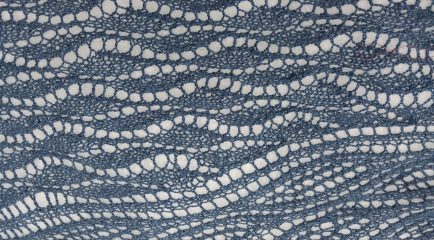


Lace is often like this. Lose concentration and you can find yourself and your stitches in a muddle. And the thing about knitting lace is it’s almost impossible to correct mistakes. The structure, with all its intentional gaps, the pulling together and drawing apart of threads, means you can’t just unravel it and pick it up again like you can with a plain sock or sweater. The structure you’ve laboured so long to create disappears.

skeena-estuary
Photo: Tavish Campbell
Which brings me to the Skeena estuary. It is re-drawn daily by the tides, weekly by the weather and seasonally by the collection and release of the rain and snow that has fallen throughout the watershed. It has a long history, a place more layered and complex than any lace. You can’t break the pattern and expect to be able to fix it later.


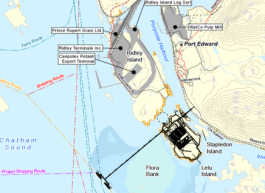
overview-of-lng-plantIf you plunk an LNG port* on Lelu Island, stretch a bridge across Flora Banks and the eelgrass where salmon smolt gather to the tanker dock at the edge of Chatham Sound, drill, blast, dredge and set up a huge humming structure complete with gas flares and tankers, well you’ve unravelled something that’s taken thousands of years to emerge from the debris of our last ice age.

How ironic to even consider building this example of Anthropocene hubris in this spot. If you add the expansion to the fracking chaos of northeastern BC this project will necessitate to its enormous greenhouse gas emissions, you’ll be speeding up the final melting of ice that began the process, thousands of years ago to create the Skeena estuary. The melting could well see the whole LNG structure itself lost beneath tidal surges within decades.

Maybe we should send Justin Trudeau, Catherine McKenna and Christy Clark each a fragment of unravelling lace and see how well they can pick up the stitches to re-establish the pattern. All while treading water.

* If you want to know more about Petronas’s LNG project, a project approved by the Canadian government just days before it ratified the Paris agreement on climate change, check out Skeena Watershed Conservation Coalition’s video.

Thanks to Graeme Pole for the images from No More Pipelines.


Sunday, September 25, 2016

Hair straight back


No, I'm not talking about those equinox storms that are beginning to appear. I'm talking about the whirlpool of threats, hearings, events, decisions, comment periods, interventions and even fun happening in the Skeena watershed and on the coast these days.


River Days 2016


First of all - the fun. Yesterday, because of the generosity of Skeena Watershed Conservation Coalition, we got to join a one-hundred strong paddle down the Bulkley from Quick to Telkwa - thanks to all the organizers who put together the event.


Enbridge and an oil tanker moratorium - Sept. 30 deadline for input

If you want to keep up-to-date on what's happening around what looks like another end to Enbridge's plans to build a bitumen pipeline across three watersheds, here's a place to go: Friends of Morice-Bulkley. If you'd like to add your voice to the request to ask for a tanker moratorium that is:
  • legislated, 
  • has no sunset clause, and 
  • covers at least Hecate Strait, Dixon Entrance and Queen Charlotte Sound
go to Let's Talk Marine Transportation in Canada.
You have until Sept. 30.

Pipelines, pipelines, where ever you look


Of course, the Enbridge project, tied as it is to tar sands oil extraction, is not the only threat to water and climate. Kinder Morgan's proposed expansion, Energy East and other bitumen pipelines are being questioned by people across the continent. A CBC September 22 news story outlined the stand taken by 50 aboriginal groups in North America:

Aboriginal tribes from Canada and the northern United States signed a treaty on Thursday to jointly fight proposals to build more pipelines to carry crude from Alberta's oil sands, saying further development would damage the environment.

The treaty, signed in Montreal and Vancouver, came as the politics around pipelines have become increasingly sensitive in North America, with the U.S. Justice Department intervening last week to delay construction of a contentious pipeline in North Dakota.

The Treaty Alliance Against Tar Sands Expansion was signed by 50 aboriginal groups in North America, who also plan to oppose tanker and rail projects in both countries, they said in a statement.
Targets include projects proposed by Kinder Morgan Inc, TransCanada Corp and Enbridge Inc.

Lelu Island and LNG - Sept. 30 deadline for input

Pipelines aren't the only threat to the Skeena Watershed. To quote Friends of Wild Salmon,

Next Friday, September 30, Prime Minister Justin Trudeau is expected to make a decision on whether to approve Pacific Northwest LNG's plant on Lelu Island in the Skeena estuary. Not only does his decision have potentially dire implications for Skeena wild salmon, it would create one of Canada's largest single sources of greenhouse gas pollution.

So much for clean green energy, Christi.

If you'd like to raise your concerns before Friday, click on the Wild Salmon link and follow the directions given.

Site C 

And just in case you don't think these things are related, it's pretty clear that much of the power the Site C dam would create is planned to fuel the fracking industry wreaking havoc in northeastern BC and elsewhere, the same industry that would have to expand significantly to fuel the Lelu Island project. Site C has never been subjected to BC's own economic and energy needs scrutiny under the aegis of the BC Utilities Commission. It's not being built to power electric cars.

For an overview, check out Amnesty International's campaign.

How about a national plan to curb carbon emissions? 

How about it!

How to make sense of it all?

We got to see To the Ends of the Earth in Smithers last week. It's a great documentary doing a damn fine job of untangling the Ponzi economics of energy production. If you get a chance, go see it.

Tuesday, June 28, 2016

Lelu Island and Flora Banks

We were in Prince Rupert to attend Neil Sterritt's event at the Museum of Northern BC on May 12. He was presenting his new book, Mapping My Way Home: A Gitxsan History, to the community. It's always a treat to attend an event there - the place is beautiful in itself, and the exhibits are always interesting.


Earlier that day, we paddled out of Port Edward past Lelu Island and over to Flora Banks in the north arm of the Skeena River estuary. The camp on the island was in place, a sailboat anchored just offshore, but we continued around, hoping to cross the mouth of the estuary to Kitson Island. 


The winds were against us and we pulled ashore on a sandy beach to eat lunch and watch the tide go out, exposing the shoals that fill the area. A choppy crossing turned into an expanse laced with long sand fingers that reached well out into the estuary. The several eagles we watched as we left Port Edward turned into several dozen birds lined up with the seagulls on these sandy stretches. 

Eelgrass, so important to young salmon, grew at the river's edges.


The Petronas LNG project proposes to level Lelu Island to situate the plant; the bridge to the site where the tankers would dock will cross the area show in the photo above. It is impossible to imagine this happening without severely affecting the estuary. Later on our way home, we stopped to look back down the Skeena, still in tidal water.


We can only hope this river, one of the few intact watersheds in BC, will not have to face this project.

Lelu, Lelu, Lelu, Lelu. I'll have to find out where that name comes from.